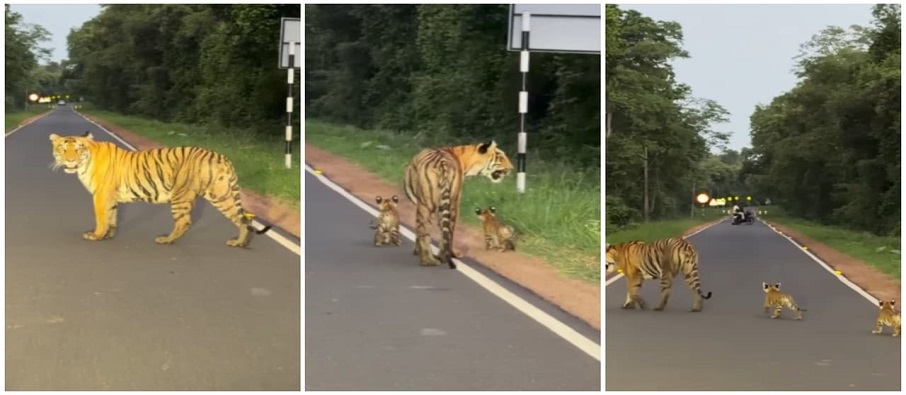
Spellbound Moment during Tadoba Safari on July 15, 2026 - Choti Madhu with Her 3 Cubs Spotted Crossing Roads
A routine safari in Tadoba-Andhari Tiger Reserve transformed into an extraordinary wildlife encounter on July 15, 2026, when visitors witnessed tigress ‘Chhoti Madhu’ walking alongside her three cubs in close proximity to their vehicle. The sighting, which occurred during an evening safari entering through the Padmapur Gate, has since attracted widespread attention across social media platforms.
The visitors had initially set out in search of a leopard, following recent reports of its presence in the area. After an unsuccessful attempt and a brief halt near Moharli, they resumed their journey toward Bhamdeli village. Early signs of tiger movement drew attention from nearby villagers and safari vehicles, but the animal remained concealed.
As the group began their return journey, they noticed several vehicles stationed along the roadside, indicating potential wildlife activity. Moments later, at approximately 7:03 pm, the tigress emerged unexpectedly from dense grassland just a few metres away. Demonstrating presence of mind, the driver carefully manoeuvred the vehicle to maintain a safe distance.
The encounter became even more remarkable when one cub followed the tigress onto the road, soon joined by two more. The situation briefly turned tense when an approaching motorcyclist came close to the scene, unaware of the tiger’s presence. A timely alert from the safari vehicle ensured the rider halted safely, preventing any possible conflict.
The tigress then calmly guided her cubs across the road and disappeared into the forest, concluding a rare and intimate glimpse into the life of a tiger family in the wild. Such sightings highlight the ecological richness of Tadoba National Park and underline the importance of responsible tourism and conservation efforts.
‘Explorer’ - A Tiger of Tadoba Returns to Andhra Pradesh for Territorial Claim
In another significant development linked to Tadoba’s thriving tiger population, the male tiger popularly referred to as ‘Explorer’ has resurfaced in the Jangareddigudem reserve forest region of Andhra Pradesh. The animal, which had earlier drawn attention for its long-distance dispersal across multiple states, now appears to be exhibiting behaviour associated with territorial establishment.
Wildlife officials note that the tiger, which left Tadoba as a sub-adult in late 2025, has returned as a mature individual. Unlike its earlier movement, which was largely exploratory, its current patterns suggest a deliberate attempt to secure a territory and locate a potential mate.
To support this development, the Andhra Pradesh government has proposed the relocation of female tigers to the region, with neighbouring states responding positively to the initiative. If implemented, this move could facilitate the formation of a new breeding population, contributing to the long-term conservation of the species.
Male tigers are known to assert dominance through territorial markings such as scent spraying, claw marks on trees, and strategic placement of scat. These indicators serve both as warnings to rival males and signals to females. However, establishing a territory is not without risks. Encounters with dominant resident males can lead to aggressive confrontations, often resulting in severe injuries.
The journey of ‘Explorer’ began in Tadoba’s forests when it reached dispersal age and moved beyond its natal range. Over several months, it traversed landscapes across Maharashtra, Chhattisgarh, and Telangana before reaching the Godavari basin. Its movement was meticulously tracked by forest officials using camera traps, pugmark analysis, and field observations.
The tiger’s return marks a crucial moment in understanding wildlife corridors and the expanding range of big cats in central India. It also reinforces the importance of inter-state cooperation in conservation planning and habitat connectivity.